
Hi, I’m Jiarong Li
Department of Mechanical Engineering
National University of Singapore

I develop cross-scale modelling and optimization for energy–material systems. My core theme is a power–hydrogen–heat nexus that connects renewables to hard-to-abate industries with feasible operation and verifiable impact.
Research object
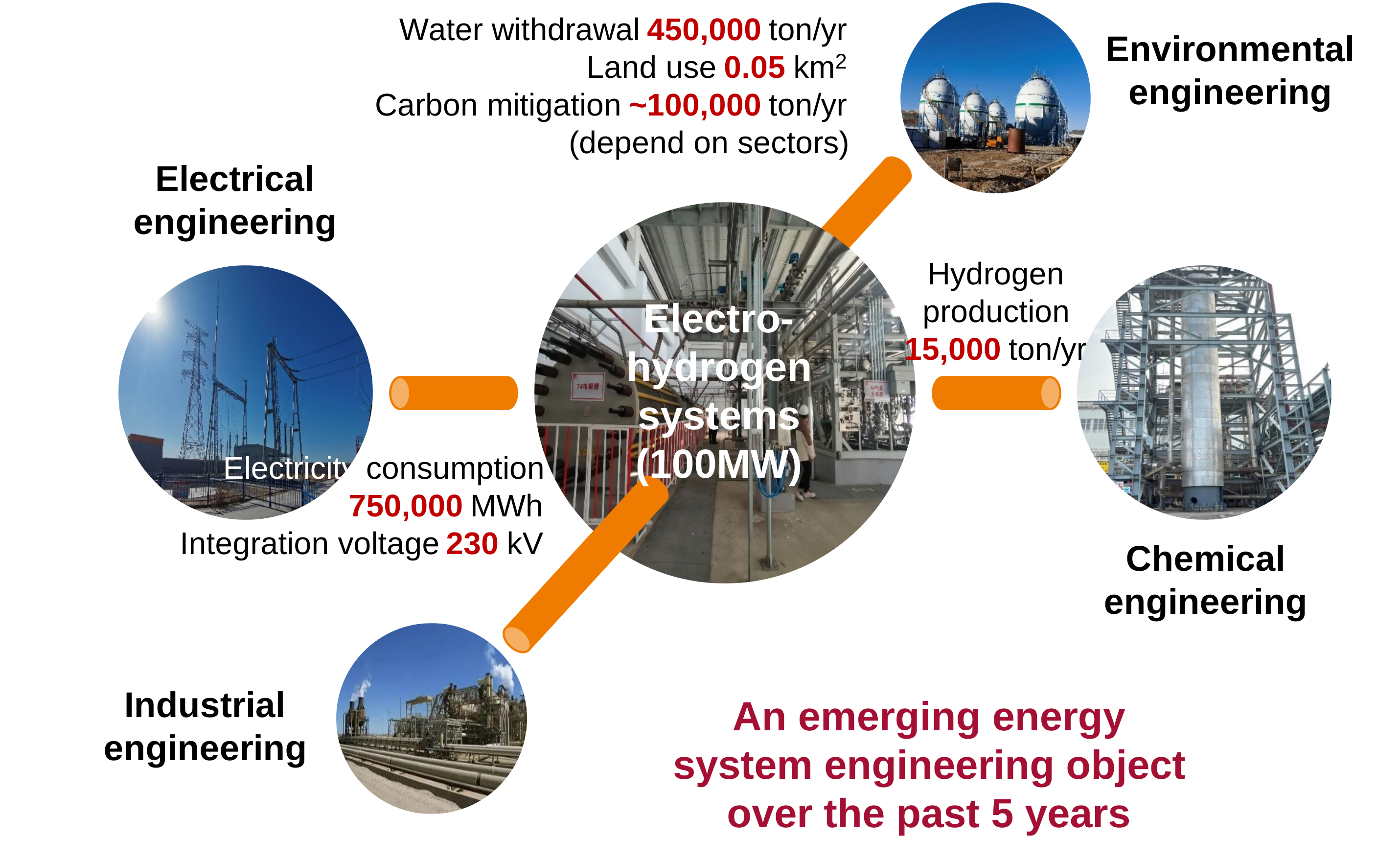
Electro-hydrogen systems
Electro-hydrogen systems are an emerging energy-system engineering object that connects electrical, chemical, industrial, and environmental engineering.
Research vision
Bridge the gap between component-level physics and system-level decisions, making power–hydrogen–heat deployment scalable, feasible, and measurable.
An evolving research paradigm
From science to engineeringThe power–hydrogen–heat nexus evolves from electrochemical reactions to deployable systems, renewable-driven adaptation, industrial electrification, and decision-ready engineering.
-
1.0Foundation
Electrochemical reactions
The scientific origin: 2H₂O ⇌ 2H₂ + O₂, governed by coupled electrical–thermal–mass behavior.
-
Reaction physics
How do electrochemical reactions convert clean electricity and water into hydrogen?
-
Coupled behavior
How do electrical, thermal, and mass-transfer dynamics determine efficiency, safety, and flexibility from the cell level?
-
Reaction physics
-
2.0Scale
Scalability of flexible electro-hydrogen systems
What is an electro-hydrogen coupling system, and how can it be scaled from the cell level to deployable project-level design and operation?
-
Equipment control
How can delayed electro-thermal dynamics be turned into controllable operating behavior?
-
Plant management
How can multiple stacks and balance-of-plant units be coordinated under efficiency, security, and compliance constraints?
-
Project design
Under review
How can systems be designed from internal topology to capacity allocation under different conditions?
-
Network operation
How can electro-hydrogen systems become dispatchable resources embedded in broader energy networks?
-
Equipment control
-
3.1Adapt
Adaptation under renewable-driven conditions
What new conditions emerge in renewable-driven systems, and how should electro-hydrogen coupling systems adapt to them?
-
Variability → Flexibility
How do electro-hydrogen systems preserve flexibility under variable renewable input?
-
Spatiotemporal mismatch → Coordination
How do they create coordination value across misaligned resources and demand?
-
Non-stationarity → Resilience
Under review
How do they preserve resilience when climate and resource boundaries shift over the long term?
-
Value deflation → Sustainability
How do they preserve sustainability and avoid declining system value?
-
Variability → Flexibility
-
3.2Electrify
Electrification of chemical industries
What new challenges emerge in electrifying ammonia and methanol production, and how should electro-hydrogen systems address them?
-
Operation mode
How can originally inflexible chemical loads be redesigned into partially flexible operating modes?
-
Process configuration
How should conventional processes be reconfigured into viable renewable production systems?
-
Supply chain
How should supply chains be restructured to match renewable resources and remain compatible with regional grids?
-
Compliance
How can electrified pathways deliver decarbonisation while remaining systemically sustainable?
-
Operation mode
-
4.0Next frontier
AI-enabled standardized digital engineering
What sensing, data, and model hierarchy is required to make electro-hydrogen systems digitally observable and controllable as standardized industrial modules?
-
Data and sensing
What should be sensed and standardized across stack, equipment, and project levels?
-
Digital twins
How can multi-fidelity physics and industrial data be coordinated for system cognition?
-
Autonomous control
How can control and energy management become autonomous while remaining trustworthy?
-
Data and sensing
-
5.0Next frontier
Human-in-the-loop decision intelligence
How can high-level hydrogen strategy be translated into localized, real-world deployment across the entire value chain?
-
Sector level · Quantity
How much hydrogen should each sector deploy under local resource and policy constraints?
-
Supply-chain level · Route
Which production, transport, and supply routes best connect resources with demand?
-
Project level · Design
How should individual projects be configured for credible and feasible deployment?
-
Operation and trading
How should deployed assets be operated and traded under changing system conditions?
-
Sector level · Quantity

Outcomes
-
PublicationsScholar
Selected and full list on Google Scholar.
-
Software & datasetsOpen
Reproducible capsule: Code Ocean · 10.24433/CO.3158796.v1
GitHub profile: github.com/twm0928
 Scorpio
 INTJ
Energy management, recovery, emotional stability, and long-horizon consistency.
Financial resilience, career optionality, and high-signal relationships.
Reading-driven world modeling, field observation, and culture-aware learning.
Skill stacking and creative practice that sustain meaningful output.
Contact
Email: twm0928@163.com
LinkedIn: jiarong-li-abb5a4142
Collaboration
If you’re working on hydrogen-integrated power systems, power–chemical coupling, or scalable P2X deployment, I’d be happy to collaborate on modeling, optimization, and dataset-driven evaluation.